Lack of adoption is not a technology problem,
it is a learning problem.
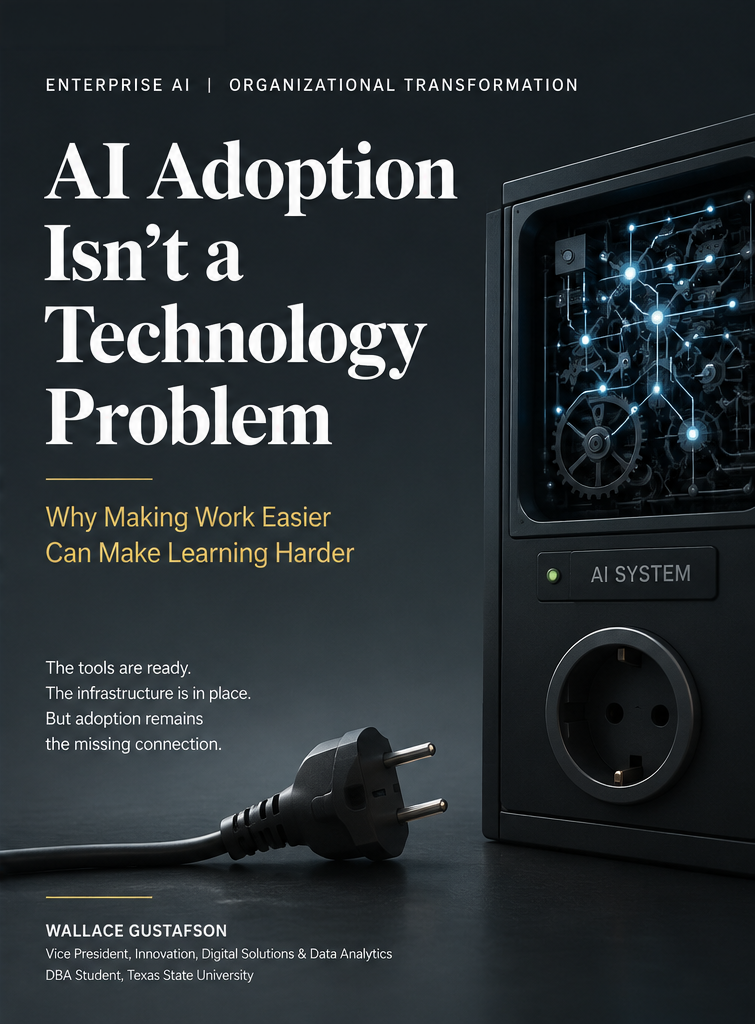
AI Adoption Isn't a Technology Problem
Why Making Work Easier Can Make Learning Harder
Legacy organizations are investing heavily in AI, yet frontline adoption consistently falls short.
The culprit isn't the technology. It's how we're teaching people to use it.
Wallace Gustafson
Vice President, Innovation, Digital Solutions & Data Analytics · DBA Researcher, Texas State University | Brief: Excerpt from a research paper.
Introduction
Legacy organizations are investing heavily in Artificial Intelligence (AI)-powered tools to streamline and digitize work, yet frontline workers, the
intended users of many of these tools, often demonstrate weak adoption. Adoption tends to increase when AI handles tasks employees prefer to avoid.
However, resistance, pushback, or even defiance may occur when technology changes work employees consider central to their role or creates a perceived
loss of autonomy. In June 2025, HR Drive reported on a Kyndryl study of 1,000 CEOs in which nearly half said their employees were either resistant to or
openly hostile toward AI (HR Drive, 2025).
One challenge organizations often fail to recognize is the Simplicity–Complexity Paradox surrounding AI: as AI makes tasks simpler, the learning and adoption experience can become more complex. At the heart of this research is the premise that lack of AI adoption is not primarily a technology problem; it is a learning and people problem. Yet many AI rollouts continue to rely on a one-time training approach, such as a single video or Standard Operating Procedure (SOP), followed by the expectation that employees will immediately incorporate the technology into their work.
The challenge is further complicated by differences in employees’ propensity to trust AI (Gibbard et al., 2024). Legacy organizations may include frontline employees who have worked in their industries for more than 25 years and began their careers before widespread adoption of cell phones, laptops, and the internet. Organizations do not always meet these employees where they are in terms of preferred learning modes or technological comfort. At the same time, the newest generation of frontline workers may enter the workforce already highly fluent in AI. If legacy organizations fail to address these differences and improve AI adoption, continued investment in AI could slow. The consequences may extend beyond technology gaps and competitive disadvantage to the longer-term risk of organizational obsolescence.
AI Adoption
Communication consistently emerges in the literature as a critical factor in AI adoption, with research suggesting that how AI is introduced to employees may matter as much as the technology’s capabilities. Whether described as providing clear “why” explanations (Gibbard et al., 2026) or communicating “reasons for” and “reasons against” adoption (Pillai et al., 2024), the literature indicates that communication shapes employee perceptions of AI. A recurring tension is that perceived usefulness must outweigh perceived threats. Even when AI delivers meaningful efficiency or performance improvements, concerns about job displacement, loss of autonomy, or other perceived risks can offset those advantages. The literature also suggests that AI adoption should be viewed as a recursive, ongoing process rather than the one-time implementation event commonly seen in legacy organizations.
Perceived usefulness is among the strongest predictors of AI adoption. Gibbard et al. (2026), Castaneda et al. (2026), and Budhathoki et al. (2024) all identify perceived usefulness or perceived benefits as strongly associated with adoption. Gibbard et al. and Budhathoki et al., drawing on TAM and UTAUT, position perceived usefulness—or performance expectancy—as a key predictor of whether employees adopt AI. Similarly, Castaneda et al. (2026) and Gandhi et al. (2023) find that reducing employees’ work burden and improving perceived efficiency can encourage adoption. However, Pillai et al. (2024) demonstrate that perceived risk and anxiety can counteract these benefits, suggesting that usefulness alone may not be sufficient to drive adoption.
Psychological factors therefore represent another important component of AI adoption. The literature frequently focuses on anxiety—particularly concerns about job security—along with perceived risk and broader resistance to AI. Tong et al. (2021) and Budhathoki et al. (2024) show that anxiety and negative perceptions can significantly moderate adoption outcomes. Castaneda et al. (2026) and Budhathoki et al. (2024) also find that concerns about job displacement can reduce adoption even when employees recognize the usefulness of the technology. Similarly, Pillai et al. (2024) and Yoo (2025) identify emotional responses such as anxiety, perceived risk, and moral outrage as significant barriers to adoption. Taken together, these findings reinforce the idea that successful AI adoption requires organizations to address not only technological capability and usefulness, but also communication, trust, autonomy, employee perceptions, and the ongoing learning experience.
REFERENCES
Budhathoki, T., Zirar, A., Njoya, E. T., & Timsina, A. (2024). ChatGPT adoption and anxiety: A cross-country analysis utilising the unified theory of acceptance and use of technology (UTAUT). Studies in Higher Education, 49(5), 831–846. https://doi.org/10.1080/03075079.2024.2333937
Castaneda, A. R., Maseeh, H. I., Surachartkumtonkun, J., Shao, W., & Thaichon, P. (2026). Impact of frontline employees' perceived benefits of artificial intelligence on AI adoption and job engagement: A meta-analysis. International Journal of Hospitality Management, 133, Article 104446. https://doi.org/10.1016/j.ijhm.2025.104446
Crist, C. (2025). Nearly half of CEOs say employees are resistant or even hostile to AI. HR Drive. https://www.hrdive.com/news/employers-employees-resistant-hostile-to-AI/749730/
Davis, F. D. (1989). Perceived usefulness, perceived ease of use, and user acceptance of information technology. MIS Quarterly, 13(3), 319–340. https://doi.org/10.2307/249008
Deci, E. L., & Ryan, R. M. (1985). Intrinsic motivation and self-determination in human behavior. Plenum.
Gandhi, T. K., Classen, D., Sinsky, C. A., Rhew, D. C., Vande Garde, N., Roberts, A., & Federico, F. (2023). How can artificial intelligence decrease cognitive and work burden for front line practitioners? JAMIA Open, 6(3), ooad079. https://doi.org/10.1093/jamiaopen/ooad079
Gibbard, K., Gill, H., Powell, D., & Hausdorf, P. A. (2026). Explain it to me like I'm five: Harnessing the power of explanations to increase trust in workplace generative AI. Behaviour and Information Technology, 45(1), 40–58. https://doi.org/10.1080/0144929X.2025.2506664
Pillai, R., Ghanghorkar, Y., Sivathanu, B., Algharabat, R., & Rana, N. P. (2024). Adoption of artificial intelligence (AI) based employee experience (EEX) chatbots. Information Technology & People, 37(1), 449–478. https://doi.org/10.1108/ITP-04-2022-0287
Tong, S., Jia, N., Luo, X., & Fang, Z. (2021). The Janus face of artificial intelligence feedback: Deployment versus disclosure effects on employee performance. Strategic Management Journal, 42(9), 1607–1636. https://doi.org/10.1002/smj.3322
Yoo, J. (2025). Employee intention and resistance to AI policies: Perceived injustice, moral outrage, and social influence from an activity theory perspective. Behaviour & Information Technology. Advance online publication. https://doi.org/10.1080/0144929X.2025.2581857